7 Animal-Derived Ingredients Hiding in Everyday Makeup — Most People Never Check.
Share
You read the front of the packaging. The back is where the truth lives.
Think about the last lipstick you bought. Or the foundation. Or the eyeshadow palette you reach for every morning.
You probably remember the shade. Maybe the finish. Possibly what it cost.
Do you remember what was in it?
Most people don't. The beauty industry has spent decades making sure of that. Ingredient lists are printed small, written in INCI nomenclature that sounds like chemistry, and placed on the back of packaging that most people flip over exactly once — if at all.
But inside those ingredient lists, in many of the most popular everyday makeup products sold in India and globally, are seven ingredients that come directly from animals. Not synthesised. Not plant-inspired. From animals. Named in ways designed not to be recognised.
Here they are. Named plainly.
01. Carmine — CI 75470 / Cochineal Extract / Natural Red 4
This is the one most people are shocked by. Carmine is the red, pink, and purple pigment in a significant proportion of the world's lipsticks, lip glosses, blushers, eyeshadows, and nail products.
It is made from cochineal scale insects. The insects are dried, crushed, and processed into a dye. Approximately 70,000 insects are required to produce one kilogram of carmine. The resulting colour is vivid, stable, and long-lasting — which is exactly why the industry uses it.
It is almost never labelled 'made from insects'. It is CI 75470. It is Cochineal Extract. It is Natural Red 4. It is carmine. None of these names tell you what it actually is.
02. Guanine — CI 75170 / Pearl Essence / Crystalline Guanine
Guanine is the ingredient that gives many highlighters, eyeshadows, nail polishes, and lip glosses their shimmer and iridescence. That pearl-like, light-catching finish you find in most luminous or dewy products.
It is derived from fish scales — typically herring, or other white-scaled fish — processed into platelets that reflect light. The industry name for it is pearl essence. The packaging calls it a 'luminous finish' or a 'pearl effect'. Neither mentions fish.
Most people who would never eat fish scales apply them to their eyelids every morning without knowing.
03. Beeswax — Cera Alba / Cera Flava
Beeswax is one of the most common ingredients in lip products — lipsticks, balms, glosses, and tinted lip products. It provides structure, texture, and that characteristic smooth application. It is also widely used in mascaras and eyeliners as a thickening agent.
Cera Alba is white beeswax. Cera Flava is yellow beeswax. Both are extracted from honeybee honeycombs during commercial honey production.
A product can be marketed as 'natural' and 'gentle' and 'free from synthetic chemicals' while containing beeswax. It frequently is.
The industry's most effective trick is not lying. It is naming things in ways that make you stop asking questions.
04. Lanolin — Lanolin / Wool Wax / Wool Fat
Lanolin is the sebaceous secretion of wool-bearing sheep — a natural waterproofing agent extracted during industrial wool processing. It is an extremely effective emollient. It absorbs into skin easily, seals moisture in, and has been used in cosmetic formulations for over a century.
You will find it in lip balms, foundations, concealers, and pressed powder compacts. It is particularly common in products marketed for sensitive or dry skin — because it works. But working is not the same as being honest about what it is.
Lanolin is also one of the more common causes of contact dermatitis. If your skin has ever reacted to a lip balm or foundation that was supposed to be 'gentle', lanolin may have been the cause.
05. Shellac — Lac Resin / Laccifer Lacca
Shellac is a resin secreted by the female lac insect — Laccifer lacca — found primarily in India and Thailand. Millions of insects are required to produce a single kilogram. It has historically been used as a varnish and a wood polish.
In makeup, shellac creates the hard, glossy finish in nail polishes. It is also used as a glazing agent in pressed eyeshadow compacts, lip products, and some mascaras — providing that sealed, smooth-press finish.
In India especially, where lac cultivation is an established industry, shellac in cosmetics is rarely disclosed in plain language. The INCI name Laccifer lacca or Lac Resin does not announce itself.
06. Squalene (shark-derived) — Squalene / Shark Liver Oil
There are two versions of this ingredient in the market, and the difference between them is significant.
Squalane (with an 'a') — plant-derived, usually from olives. Safe, stable, effective, and increasingly used in clean beauty formulations.
Squalene (with an 'e') — traditionally derived from shark liver oil. Deep-sea sharks are caught specifically for their livers, which contain high concentrations of this compound. Used in foundations, primers, moisturising makeup, and some lip products as an emollient.
The single letter difference between squalane and squalene is the difference between an olive and a shark. Most ingredient lists do not explain this. Most consumers do not know to look.
07. Stearic Acid (tallow-derived) — Stearic Acid / Tallow / Sodium Tallowate
Stearic acid is one of the most widely used ingredients in cosmetic formulations. It acts as an emulsifier, a thickener, and a skin-conditioning agent. It is present in foundations, concealers, eyeshadow compacts, face powders, and lipsticks.
Stearic acid can be plant-derived — from shea butter or coconut oil. It can also be animal-derived from tallow, which is rendered beef or mutton fat.
The INCI name does not specify the source. A product can list Stearic Acid and that ingredient could be from a plant or from rendered animal fat. Without a brand that is willing to disclose the source explicitly, there is no way to know.
You check food labels. You know the difference between vegetable oil and lard. Your makeup deserves the same standard of honesty.
Why does this matter beyond ethics?
For some people this is entirely an ethical question — and that is reason enough.
But for many others there are practical concerns too. Carmine is a known allergen that causes reactions in a measurable portion of the population. Lanolin is one of dermatology's most documented contact allergens. Shellac can cause sensitisation with repeated exposure. Beeswax, in certain concentrations, clogs pores for skin types prone to congestion.
These are not rare or extreme reactions. They are common. And they are rarely attributed to the correct ingredient because most people have no idea the ingredient is there.
Knowing what is in something matters for skin health, not just conscience.
What Simree does instead.
None of the seven ingredients listed above appear in any Simree product. Not in the makeup. Not in the skincare. Not anywhere.
The Tinted Trinity uses plant-derived pigments — no carmine, no guanine, no animal-sourced colourants of any kind. The lip formulation is sealed and conditioned without beeswax or lanolin. The shimmer, where present, does not come from fish scales.
The 4D Eco Glitter is exactly what it says — eco-formulated, free from conventional plastic microplastics and animal-derived shimmer. Packaged consciously. Made to be worn on your face and your body without the questions that follow most glitter products.
Every face oil and serum in the range uses olive squalane — not shark squalene. Every emollient is plant-sourced. Every pigment is disclosed.
→ Tinted Trinity — Lip, Eye & Cheek Tints — Plant-derived pigments. No carmine, no guanine, no beeswax. Colour with nothing to hide. View Product →
→ 4D Eco Glitter — Face & Body — Eco-friendly packaging. No animal-derived shimmer. The finish you want, built the right way. View Product →
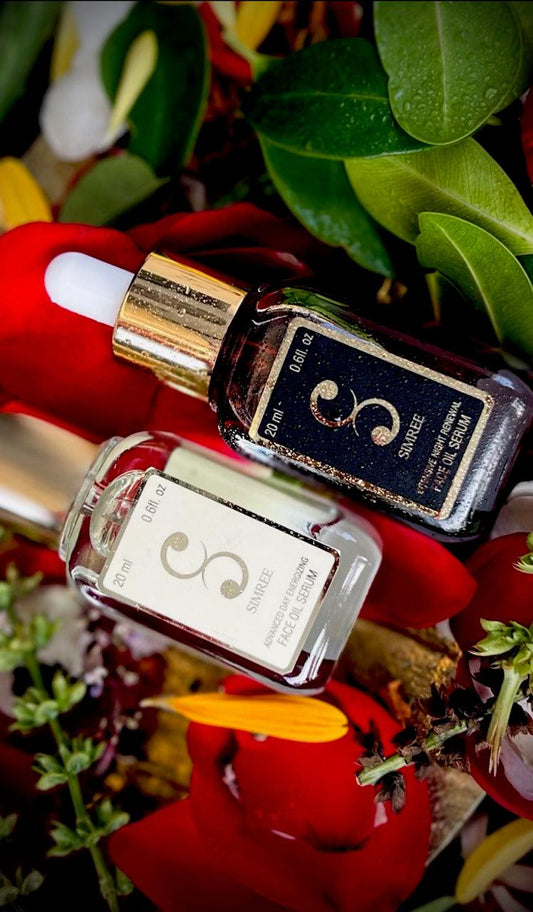
→ Advanced Day Energizing Face Oil Serum — Olive squalane — not shark squalene. Blue Tansy, Jojoba, Rosehip. The source of every ingredient is the point. View Product →
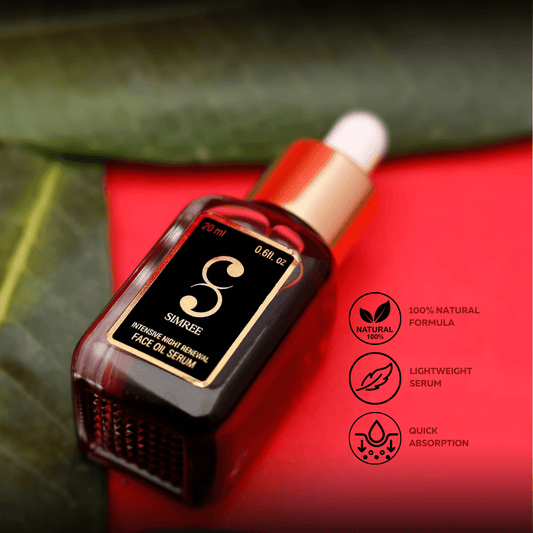
→ Intensive Night Renewal Face Oil Serum — Saffron and Bakuchi. No animal-derived collagen. No tallow-sourced stearic acid. Anti-ageing built entirely on plant intelligence. View Product →
→ Acne Control Balancing Face Mist — Blue Tansy, Neem, Tea Tree. No lanolin. No shellac. Every ingredient a plant. Every ingredient named. View Product →
One thing to do today.
Pick up one makeup product you use every day. Flip it over.
Look for: Carmine. CI 75470. Cera Alba. Guanine. CI 75170. Lanolin. Lac Resin. Squalene. Stearic Acid without a stated source.
You may find none of them. You may find several.
Either way — now you know what to look for. That is the only thing between you and an informed choice.
Your nani knew what was in her pot. You can too.
At Simree
No animal-derived ingredients. In any product. In any category. Not as a policy — as a conviction. The full ingredient list for every Simree product is available in plain language.
Explore all Simree makeup at simreecosmetics.com/collections/makeup-1.
Read the full ingredient library at simreecosmetics.com/pages/simree-natural-ingredients.
— Simree Cosmetics | www.simreecosmetics.com